

Universal Epic Universe:
Real-Time Digital Twin for Celestial Park
How ARS partnered with Universal to build a complete digital twin of Celestial Park at Universal Epic Universe, using Unreal Engine 5, Nanite, and advanced lighting systems to validate the theme park's architectural and entertainment systems before construction was complete.
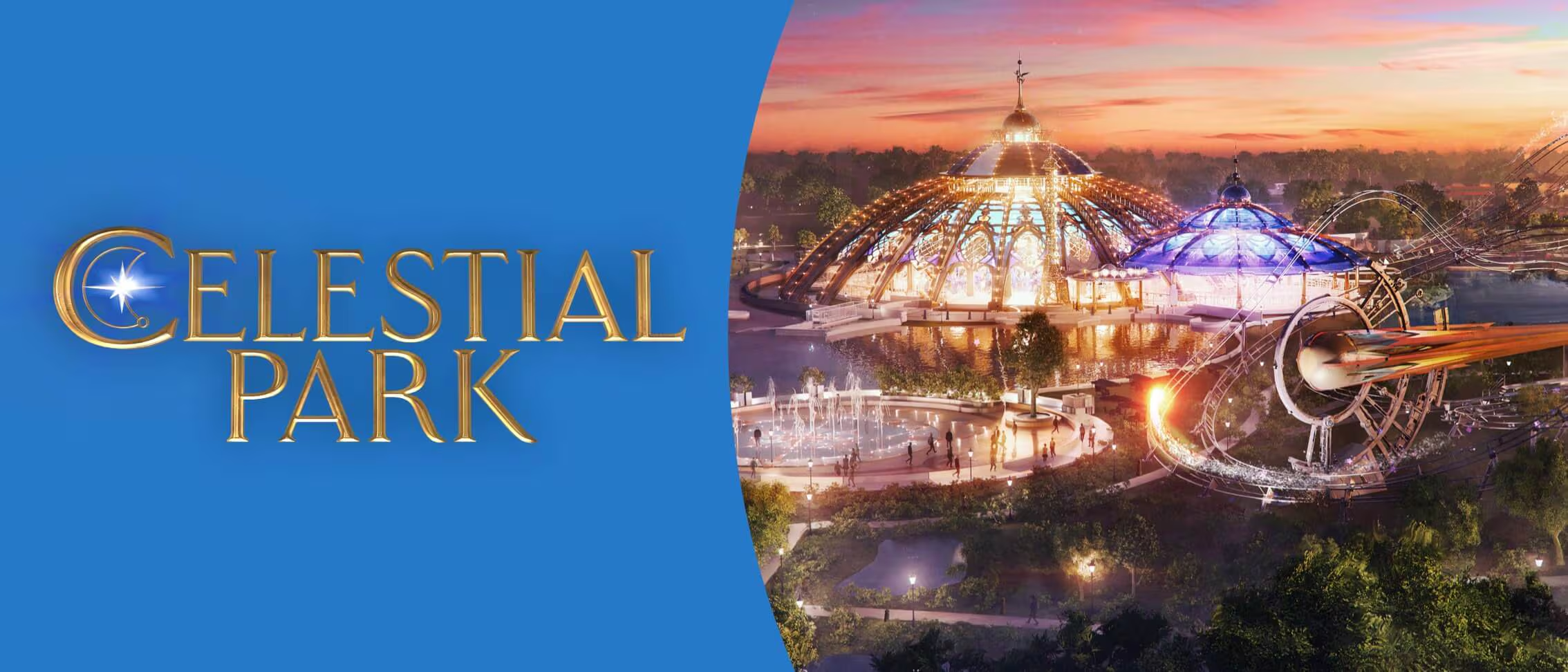
Celestial Park Digital Twin
Explore Celestial Park at scale through a real-time simulation.
Universal Epic Universe Celestial Park Digital Twin
A view of Celestial Park at Universal Epic Universe, with thousands of assets, construction materials, and lighting fixtures rendered in real-time nighttime conditions ahead of the park's 2025 opening.
Real-Time DMX Hardware Integration
Shows 1:1 control between the digital twin and physical lighting hardware. The software interface on the left drives the virtual strip lights through Art-Net/sACN protocols.
Megalights: Massive Scale Simulation
Tests complex lighting scenarios with thousands of dynamic sources. This rainbow-pattern test checks signal integrity across the landscape network.
The Universal Challenge
Celestial Park includes thousands of interconnected lighting fixtures, complex architectural systems, and precise guest-experience requirements. Static documentation could not capture the changing interactions needed for validation.
Universal needed a solution that paired scientific accuracy with cinematic fidelity to validate lighting systems, train computer vision models for operations, and pre-program entertainment sequences before the physical park opened.
The ARS Solution
- Geometric Sovereignty: Nanite handled billion-polygon datasets without decimation.
- Physically Based Lighting: Validating guest safety and experience with measurable units: Candela, Lumen, and Lux.
- Pre-Programming Entertainment: Universal's creative team programmed and visualized lighting shows months before the park opened.
Technical Architecture
The workflow brings engineering data into a real-time 3D environment.
Real-Time Fidelity
Unreal Engine 5's Lumen updates dynamic global illumination as geometry changes instead of relying on static baked lighting.
Key Advantages
| Feature | Impact |
|---|---|
| Lumen GI | Immediate feedback for design changes |
| Path Tracing | Cinematic-quality lighting validation |
Geometric Sovereignty
Nanite imports raw LiDAR scans and high-poly CAD models while retaining as-built accuracy.
Nanite Capabilities
Physically Based Lighting
Our digital twins use industry-standard photometric units to compare the virtual environment with the physical installation.
Supported Units
Megalights Architecture
We simulate thousands of shadowed, dynamic area lights, including LED nodes and stadium fixtures, while maintaining performance.
Synthetic Training Data
We generate high-fidelity datasets for computer vision models, including rare edge cases, weather conditions, and lighting scenarios that are impractical or too costly to capture in the physical world.
Applications
DMX & Control Protocols
The Celestial Park digital twin used the same real-world lighting control systems as the physical park: grandMA3 consoles via Art-Net/sACN. It allowed Universal's entertainment team to pre-program complex nighttime spectaculars before the land opened.
Capabilities
Strategic ROI
A comparison of offline rendering and ARS's real-time workflow.
| Metric | Traditional Offline Workflow | ARS Real-Time Workflow |
|---|---|---|
| Iteration Speed | Hours or days per render | Immediate real-time feedback |
| Deliverable Versatility | Static 2D images | VR, AR, web, video, and stills from one source |
| Project Completion | Standard Timeline | Up to 60% Faster |
| Validation Accuracy | Approximations | Measured photometric units (Lux/Cd) |
Plan a Real-Time Digital Twin
ARS builds digital twins for theme parks, stadiums, and smart cities.